The Feelings Wheel
The feelings wheel was first introduced in 1982 by Gloria Wilcox [1]. While not exhaustive, it is a helpful tool for helping individuals grow in their emotional intelligence by increasing their vocabulary of emotion words.
The Feelings Wheel Image
Reposted with permission from The Feelings Wheel app by Common Zen Media.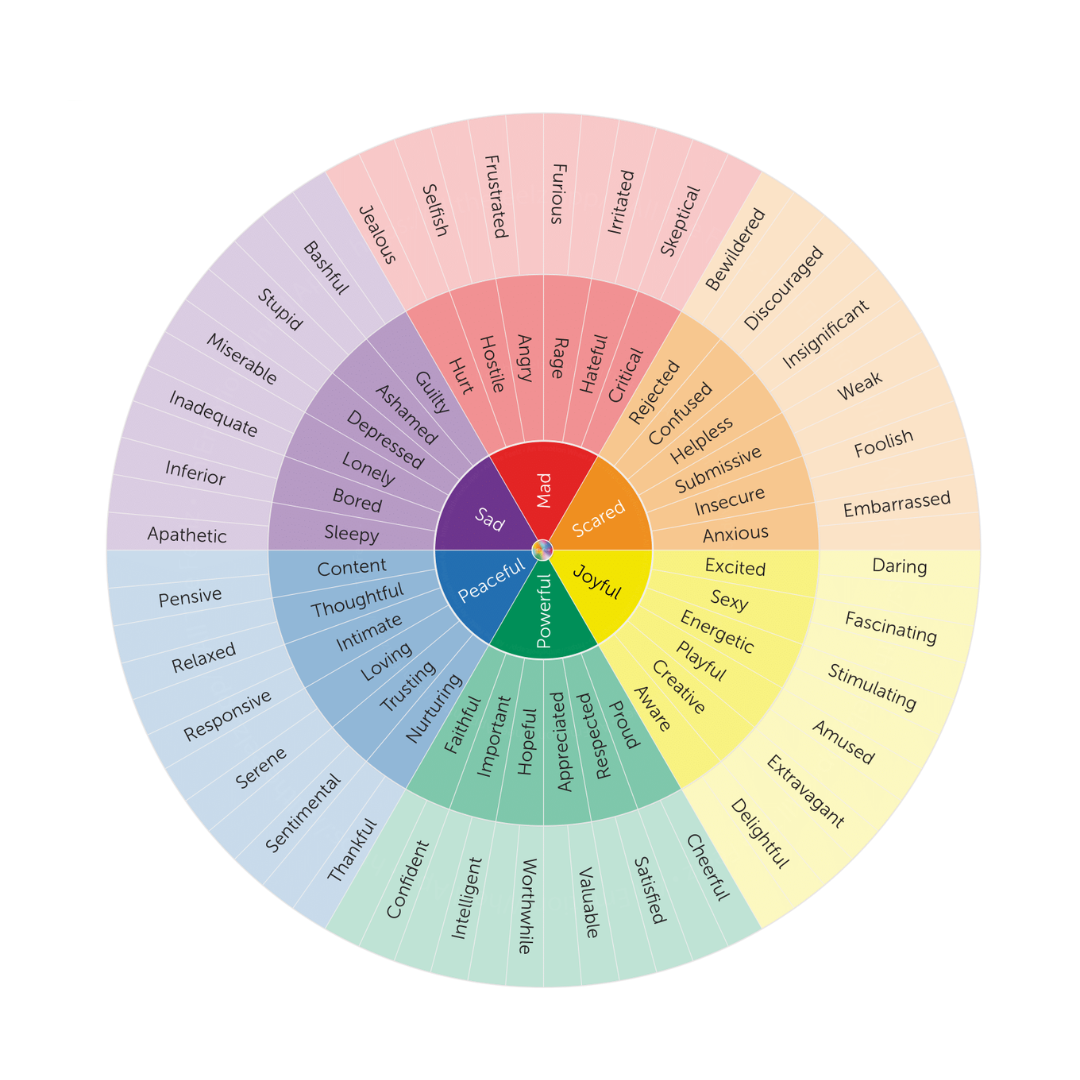
Advice
Quoted directly from a PDF labeled "Positive Psychology Practitioner's Toolit"[2]
- Note that the feelings depicted in the Feeling Wheel (see fig. 1) are not a complete overview of all possible feelings and emotions. Rather, they serve as a guide and starting point that may help clients to describe their experiences.
- Although this exercise can be used in many ways, using it during the day is preferable because the immediate approach circumvents memory distortions or (inaccurate) cognitive representations of the experiences. If the client chooses to use the wheel during the day, the present tool can be nicely combined with the 3 minute coping exercise, which directs attention inward and facilitates connection with the emotional state one is in
- It can be useful for clients to carry a hardcopy of the Feeling Wheel (see fig. 1) or store a digital image on their phones, so that it can be accessed at any given time.
- Note that it is possible to experience different emotions at the same time. The emotions and feelings in the wheel are not mutually exclusive, but can exist in many combinations, even positive and negative at the same time.
- “You cannot heal what you cannot feel”: this tool can also be used when aiming to increase self-compassion. In order to develop self-compassion, it is important to pay attention to the experiences that are present, in order to take appropriate compassionate action. For instance, if a client realized that he or she experiences shame, the kind inner voice that can be cultivated can be focused on the experience of this specific emotion (“It is ok to experience shame; I am a human being and I make mistakes.” “This experience of shame tells me that I can learn from this experience so that I can do it differently next time”.)
- Note that the negative feelings in the inner band of the wheel are located on the exact opposite side of the wheel than the positive feelings. For instance, the positive core feeling that contrasts with sad is joyful. Although your client may use this information to gain insight in the positive emotions or feelings that are least present and may need further attention (see the tool: positive emotion brainstorm), this feature of the wheel should not be used to replace or avoid emotions. For instance, when a client experiences sadness, it is advisable to allow the sadness to be present rather than to try to replace it with joyful thoughts (see also the tool: acceptance of emotions).